1. Choose the Sphere Diameter
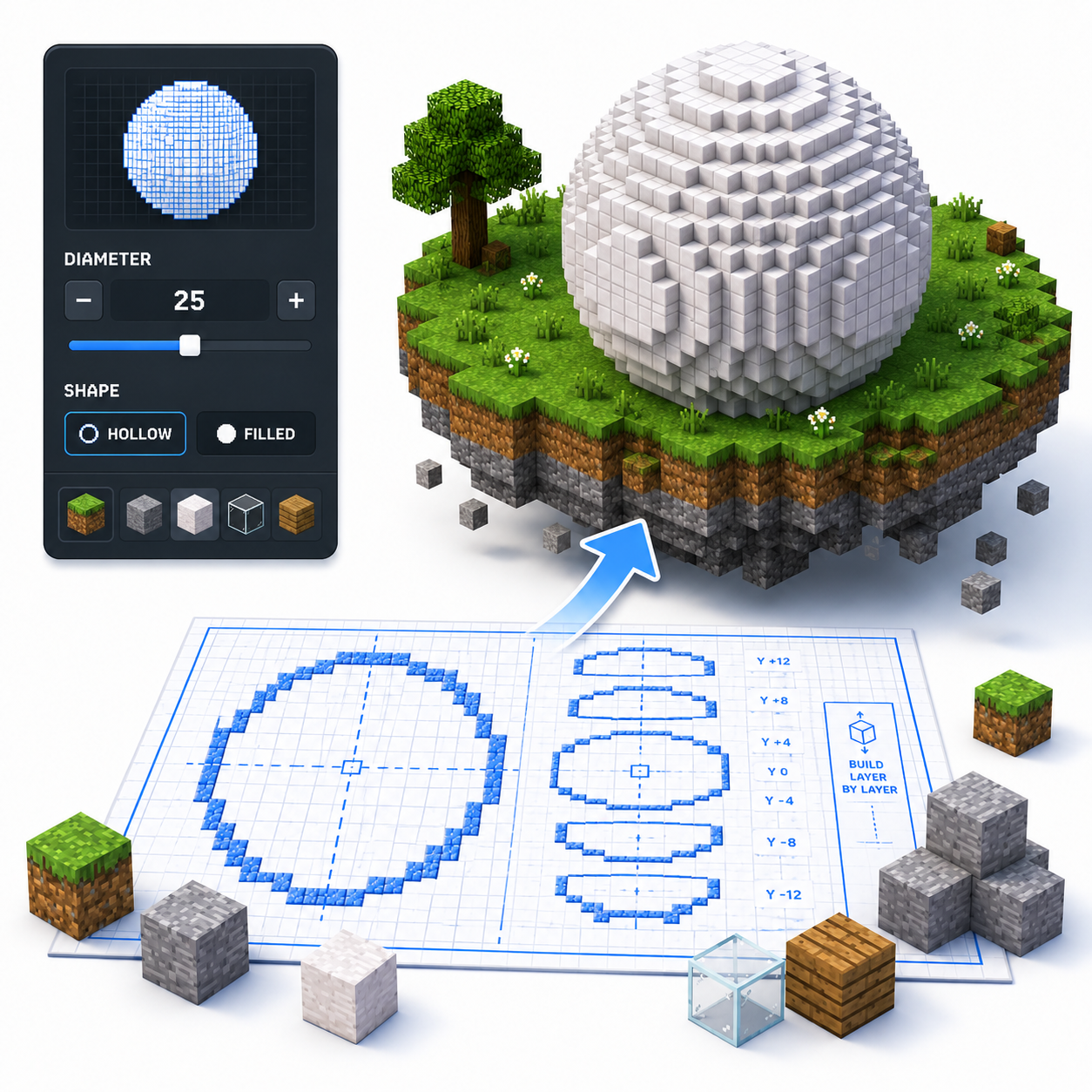
Drag the size control or enter the desired diameter. Larger diameters create smoother curves but require more blocks and more building layers.
Layer-by-layer sphere blueprint
Generate a block-by-block Minecraft sphere blueprint and view every horizontal layer before you start building.
 Loved by 6.5M+ Minecraft users
Live block grid
How it works
Drag the size control or enter the desired diameter. Larger diameters create smoother curves but require more blocks and more building layers.
Choose Hollow mode for globe buildings, observatories, planet decorations, and spherical rooms. Choose Filled mode for solid terrain shapes, decorative objects, or projects that require a complete block volume.
The generator divides the sphere into horizontal layers. Each layer shows the circle pattern that must be built at that height.
Mark the center and construct the widest layer first. Then build upward and downward using the corresponding layer patterns.
Download the layer guide as a PNG reference. Label or number each layer before building so that similar-looking sections are not placed at the wrong height.
Tool features
Plan Minecraft spheres layer by layer with diameter controls, hollow and filled modes, block counts, and downloadable blueprint references.
Set the full sphere diameter, then move through each horizontal layer to understand how the shape changes from bottom to top.
Choose hollow mode for shells and rooms, or filled mode when you need a solid decorative object or terrain form.
Review the number of blocks required for the selected layer so you can track materials and avoid mixing up similar slices.
Download the current layer as a PNG reference or export a .schem file for compatible Java Edition WorldEdit workflows.
FAQ
A Minecraft sphere generator creates a layer-by-layer block blueprint for building a three-dimensional sphere. Instead of estimating the curved surface manually, you can follow the generated circle pattern for each horizontal layer.
Choose a diameter, review the generated layers, and begin with the widest center layer. Build each successive layer above and below it, keeping all layers aligned around the same center point.
A hollow sphere contains only the outer shell, making it suitable for rooms, domes, planets, and decorative buildings. A filled sphere includes all internal blocks and requires significantly more materials.
A diameter of approximately 11-17 blocks is a manageable starting range. Smaller spheres can look very blocky, while much larger spheres require more careful layer tracking. This is an editorial starting point rather than a universal rule.
Odd diameters provide a single central block and are often easier to align. Even diameters create a central area between blocks. Both can produce accurate spheres, but their layer patterns differ.
The block count depends on the diameter and whether the sphere is hollow or filled. A filled sphere requires considerably more blocks because every interior position is included. Use the generator block count for the selected pattern.
Use the dedicated Minecraft Dome Generator when you need only the upper or lower half of a sphere. This is more convenient for roofs, observatories, and enclosed halls.
Yes. You can download the generated layer blueprint as a PNG reference and follow it while building.
Number every generated layer and mark the current height in Minecraft. Build in order from the center upward, then repeat or mirror the sequence downward.
Common uses include planets, globes, floating bases, observation rooms, decorative balls, futuristic buildings, and rounded terrain features.
Testimonials
See how Minecraft builders, streamers, survival players, and new creators use the generator to plan accurate circles, ovals, spheres, and domes faster.
The Minecraft Circle Generator is an absolute game-changer! I was struggling to create perfect circles for my builds, but this tool made it so easy. Just input the diameter and it gave me a clear blueprint to follow. The filled and outline options are perfect for different types of projects. Highly recommend it!
★★★★★I love using the Circle Generator for my Minecraft creations! It simplifies the process of building ovals and spheres, making my designs look way better. The PNG download feature is fantastic, allowing me to keep the blueprint handy while I build. This tool has really improved my gameplay!
★★★★★As a Minecraft architect, precision is key. The Circle Generator has been a lifesaver, providing pixel-perfect blueprints for all my circular designs. I particularly appreciate the layered sphere feature, which gives a clear view of each level. It is easy to use, and I cannot imagine building without it!
★★★★★I started using the Minecraft Circle Generator for my streams, and my viewers love it! It takes the guesswork out of building circles and domes, which makes for smoother gameplay. The ability to switch between outline and filled modes is a major plus. This is a must-have tool for any Minecraft enthusiast!
★★★★★This tool is simply amazing! I often struggle with making round shapes in Minecraft, but the Circle Generator provides precise blueprints that I can easily follow. The common sizes guide helped me decide on the best diameter for my builds. It has saved me so much time and frustration!
★★★★★
As a new player, I found the Minecraft Circle Generator incredibly helpful. The step-by-step guide made it easy to understand how to build circles and domes. I love that I can create blueprints for different shapes and sizes, and the tool is super user-friendly. Definitely a great resource!
★★★★★